

Build a Real Estate Photography Portfolio That Wins Clients
A real estate photography portfolio is a curated collection of 12 to 20 professional property images designed to demonstrate your technical skill, consistency, and ability to deliver what real estate agents actually need. Building one strategically is the difference between getting ignored and getting booked. Tools like Squarespace, Adobe Lightroom, and AutoReel now make it possible to create a polished, client-ready portfolio in under a week. Whether you are starting from scratch or refining an existing showcase, this guide covers every step to build a real estate photography portfolio that converts.
What do real estate agents look for in a photography portfolio?
Real estate agents are not evaluating your portfolio the way a gallery curator would. They are asking one question: “Can this photographer make my listings sell faster?” Your portfolio answers that question through technical consistency, complete property coverage, and proof that you understand MLS delivery standards.
Technical consistency is the primary quality metric agents use. Correct white balance, matched brightness across rooms, and straight vertical lines signal that you have a repeatable, professional workflow. A single overexposed kitchen or a tilted doorframe tells an agent your results are unpredictable.
Agents also want to see that you can tell a complete property story, not just photograph a pretty room. A full property narrative including exterior, interiors, twilight shots, drone imagery, and floor plans converts better than a disjointed highlights grid. This mirrors the actual deliverable agents send to buyers.
Your portfolio should cover multiple property types and shooting conditions:
- Exterior shots: Curb appeal in natural daylight and twilight
- Interior wide angles: Living rooms, kitchens, and primary bedrooms with balanced window exposure
- Twilight photography: Blue-hour exteriors that command premium listing attention
- Drone imagery: Aerial perspectives showing lot size, neighborhood context, and pool areas
- Video walkthroughs or vertical reels: Short-form content for social media and MLS platforms
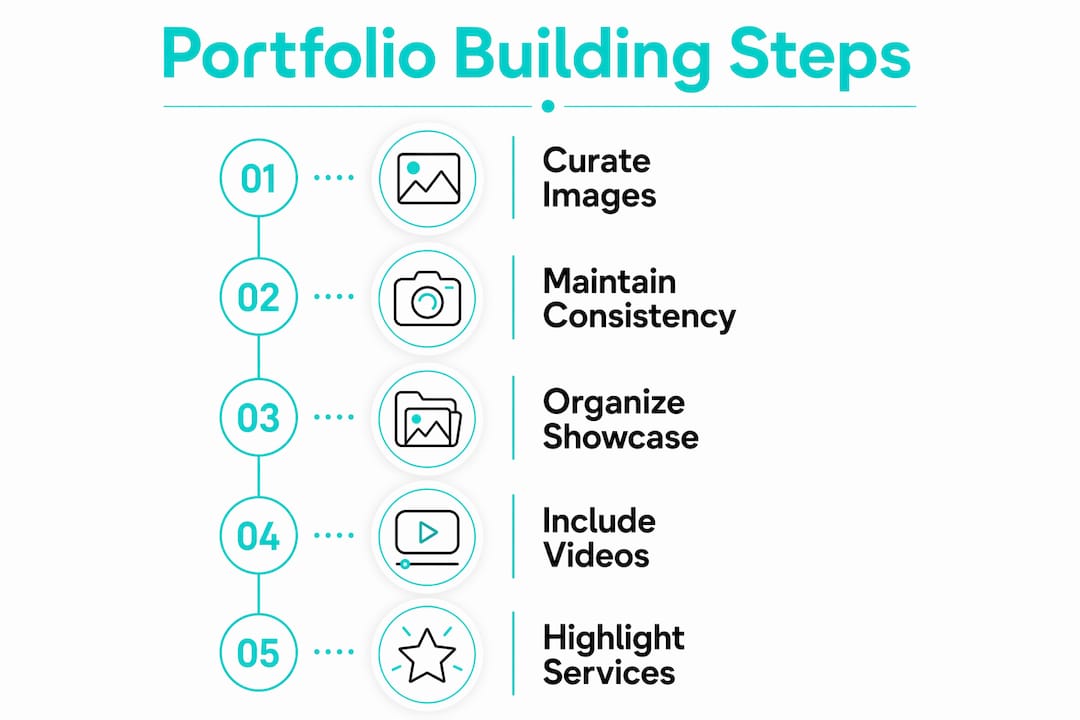
A portfolio of 12 to 20 curated images demonstrates professional curation and technical control without overwhelming the viewer. More images rarely help. Agents scan quickly, and a tight, consistent set reads as confident and professional.
Pro Tip: Include 2 to 3 complete listing showcases rather than scattering your best individual shots. Showing a full sequence from exterior to kitchen to master bath to drone mirrors what agents actually receive, which makes booking you feel like a low-risk decision.
How can beginners build portfolio images without paying clients?
The most common mistake beginners make is waiting for a paid job before building their portfolio. You do not need a client to start. You need access to a property and permission to shoot it.
Here are five proven methods to collect portfolio-worthy images before your first paid booking:
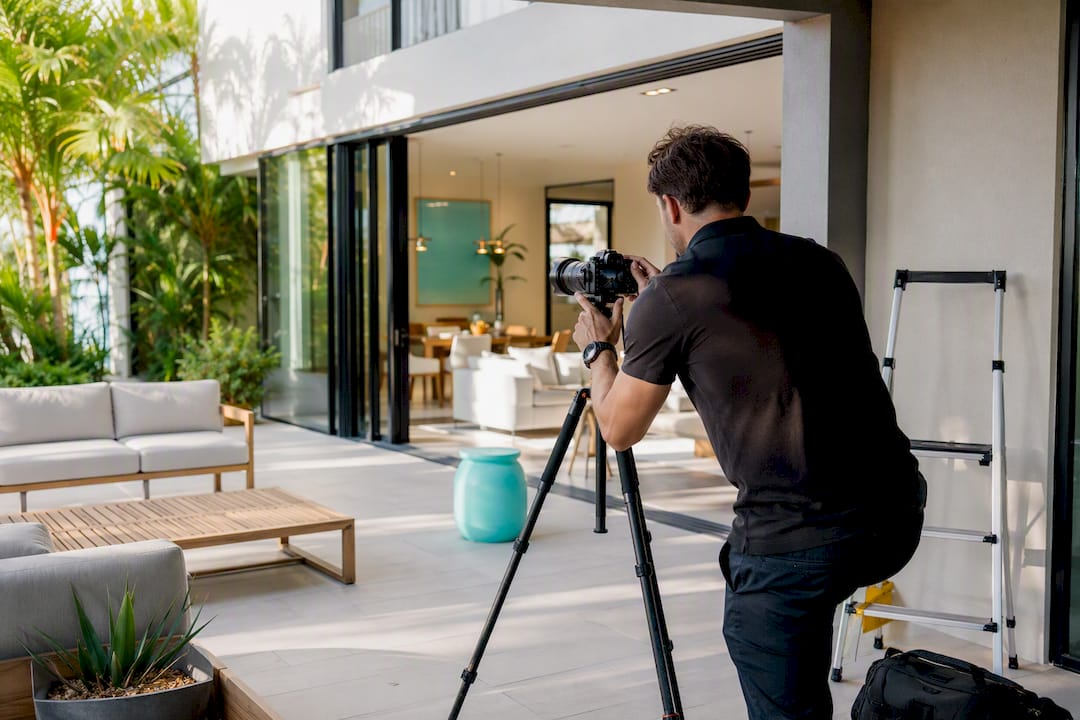
- Photograph your own home. Set up your tripod, dial in your settings, and practice shooting every room at different times of day. Your own space gives you unlimited time to refine white balance, exposure blending, and vertical correction in Lightroom or Capture One.
- Visit open houses. Attend weekend open houses and ask the listing agent for permission to photograph the property. Many agents say yes, especially if you offer to share the edited images. This gives you real-world conditions and a potential referral relationship.
- Shoot model homes and spec homes. New home builders maintain model homes specifically for marketing. Contact the sales office and offer to photograph the model in exchange for portfolio rights. Builders often appreciate free professional photography.
- Partner with newly licensed agents. New agents need listing photos but have tight budgets. Offer discounted or complimentary shoots in exchange for testimonials and portfolio usage rights. This is one of the fastest ways to build a credible portfolio quickly without waiting months for paid work.
- Use AI-assisted tools to speed up your launch. Platforms like AutoReel help you create vertical reels and walkthrough videos from still photos. Combining this with a Squarespace or Format website means you can go from zero to a live, professional portfolio in days rather than weeks.
Pro Tip: When shooting open houses or model homes, always get written or email permission before publishing the images. A simple message to the agent or builder protects you legally and builds trust from day one.
How should you organize and present your real estate photography portfolio?
Organization is where most aspiring photographers lose potential clients. A visually impressive portfolio that is hard to navigate or missing key business information will not convert. Your portfolio website is a sales tool, not an art gallery.
Structure your portfolio around complete listing showcases rather than category grids. Group images into sequences: exterior, living room, kitchen, primary bedroom, bathroom, drone, twilight. Showing 2 to 3 full showcases this way mirrors actual deliverables and increases booking likelihood because agents can visualize exactly what they will receive.
Consistent editing style across every image in your portfolio is non-negotiable. A signature style built on technical consistency rather than artistic variation builds client trust in your reliability. Use the same Lightroom preset family, the same window exposure approach, and the same color temperature across all portfolio images.
Here is a comparison of portfolio presentation approaches and their impact on client conversion:
| Approach | Client Impact |
|---|---|
| Scattered highlights grid | Confusing. Agents cannot assess your workflow or deliverable quality. |
| Full listing showcases (2 to 3 properties) | Clear. Agents see exactly what they will receive from start to finish. |
| No pricing or turnaround info | Friction. Agents must contact you just to qualify your services. |
| Upfront pricing and 24-hour turnaround | Trust. Agents book faster when expectations are set immediately. |
| No booking form | Lost leads. Agents move on to the next photographer with a simple contact process. |
Your portfolio website must also function as a business tool. Portfolio sites with instant booking and clear packages outperform static galleries. Platforms like Squarespace or Zenfolio support package tiers, booking forms, and calendar integrations with tools like Acuity Scheduling or Wix Bookings.
Display your Part 107 drone certification, turnaround times, and MLS-ready file delivery clearly on your services page. These details are vital professional signals to agents who need to trust you with a listing deadline.
What role does video play in your portfolio success?
Video is no longer optional in real estate photography. Agents expect it, buyers watch it, and your portfolio needs to show you can deliver it. Including 1 to 2 video examples such as vertical reels or walkthroughs alongside your photos improves portfolio competitiveness in a video-first market.
Agents expect turnaround times of 24 to 48 hours for both photos and video. This means your workflow needs to be fast and your editing process repeatable. AutoReel and similar tools allow you to generate social-ready vertical reels from your still photos, which is a practical way to add video deliverables without a full video production setup.
Your portfolio website itself must perform well on mobile. Most agents browse on their phones between showings. A slow, desktop-only portfolio site loses you bookings before the agent even sees your images. Squarespace and Format both offer photographer-optimized templates with mobile-responsive layouts and built-in booking integration.
Key elements your online portfolio must include:
- Fast load times: Compress images to under 500KB without visible quality loss using tools like TinyPNG or Lightroom’s export settings
- Clear navigation: Home, Portfolio, Services, Pricing, and Contact pages with no more than five menu items
- Booking form with qualifying questions: A streamlined inquiry form asking for property address, shoot date, session type, and budget improves lead quality and saves you time
- Pricing transparency: List your standard packages, rush fees, and drone add-ons so agents can self-qualify before reaching out
Pro Tip: Add a short “About” section that mentions your turnaround time and file delivery format in the first two sentences. Agents read this before they look at your images. Knowing you deliver MLS-ready JPEGs within 24 hours removes the biggest friction point in their decision.
Key takeaways
A real estate photography portfolio converts clients when it combines technical consistency, complete property narratives, transparent business information, and a mobile-ready website with booking integration.
| Point | Details |
|---|---|
| Curate 12 to 20 images | A tight, consistent set signals professional control better than a large, uneven gallery. |
| Show full listing sequences | Group exterior, interior, twilight, and drone shots together to mirror real deliverables. |
| Display pricing and turnaround upfront | Clear business info reduces friction and increases inquiry quality from serious agents. |
| Add 1 to 2 video examples | Video reels or walkthroughs demonstrate versatility and align with current agent expectations. |
| Use a booking-integrated website | Platforms like Squarespace or Zenfolio turn your portfolio into a functional sales tool. |
What I have learned about portfolios that actually book jobs
After years of working with photographers and real estate professionals across Phoenix, I have seen one pattern repeat itself: the photographers who get consistent bookings are not always the most talented. They are the most readable. Their portfolio tells an agent exactly what they will get, how fast they will get it, and what it will cost.
The biggest mistake I see is what I call the “mood board” portfolio. It looks beautiful. It has dramatic twilight shots, perfectly staged kitchens, and maybe a drone photo of a mountain view. But it has no pricing, no turnaround time, no booking form, and no sense of what a complete deliverable looks like. An agent visiting that site has to do too much work to figure out if you are the right fit. They move on.
The portfolios that convert treat the website as a sales funnel. They show 2 to 3 complete property sequences, list packages clearly, and make booking a one-step process. I have also found that photographers who mention their exposure triangle mastery and technical workflow in their About section get more inquiries from experienced agents who have been burned by inconsistent photographers before.
One more thing: do not underestimate the value of local specificity. A portfolio that shows Phoenix properties, mentions Arizona drone permit compliance, and references MLS standards for the Arizona Regional Multiple Listing Service speaks directly to the agents you are trying to reach. Generic portfolios get generic results.
— Justin
See how a professional portfolio is built in practice
At JFPhotos, we have spent over a decade building a professional photography portfolio across weddings, events, portraits, and commercial work in Phoenix, AZ. Our approach to every shoot reflects the same principles that make real estate portfolios work: technical consistency, fast turnaround, and images that serve the client’s actual goals. If you are building your real estate photography business and want to see what a client-ready portfolio looks like in practice, explore our photography services for examples of professional presentation, booking integration, and package structure you can model for your own work. Ready to take the next step? Contact JFPhotos today.
FAQ
How many images should a real estate photography portfolio include?
A real estate photography portfolio should include between 12 and 20 of your best images. This range demonstrates professional curation and technical control without overwhelming agents who scan quickly.
Can I build a portfolio without any paying clients?
Yes. You can build a credible portfolio by shooting your own home, visiting open houses with permission, photographing builder model homes, or partnering with newly licensed agents for free or discounted shoots.
What is the best platform for a real estate photography portfolio website?
Squarespace and Format are the top choices for real estate photographers. Both offer mobile-responsive templates, booking form integration, and package tier displays that turn your portfolio into a functional business tool.
Do I need to include video in my real estate photography portfolio?
Yes. Including 1 to 2 video examples such as vertical reels or property walkthroughs is now expected by most agents. Tools like AutoReel allow you to create short-form video content directly from your still photos.
How do I make my portfolio stand out to real estate agents?
Show complete listing sequences rather than scattered highlights, display your turnaround time and pricing upfront, and include a simple booking form. Agents prioritize photographers who make the hiring decision easy and low-risk.